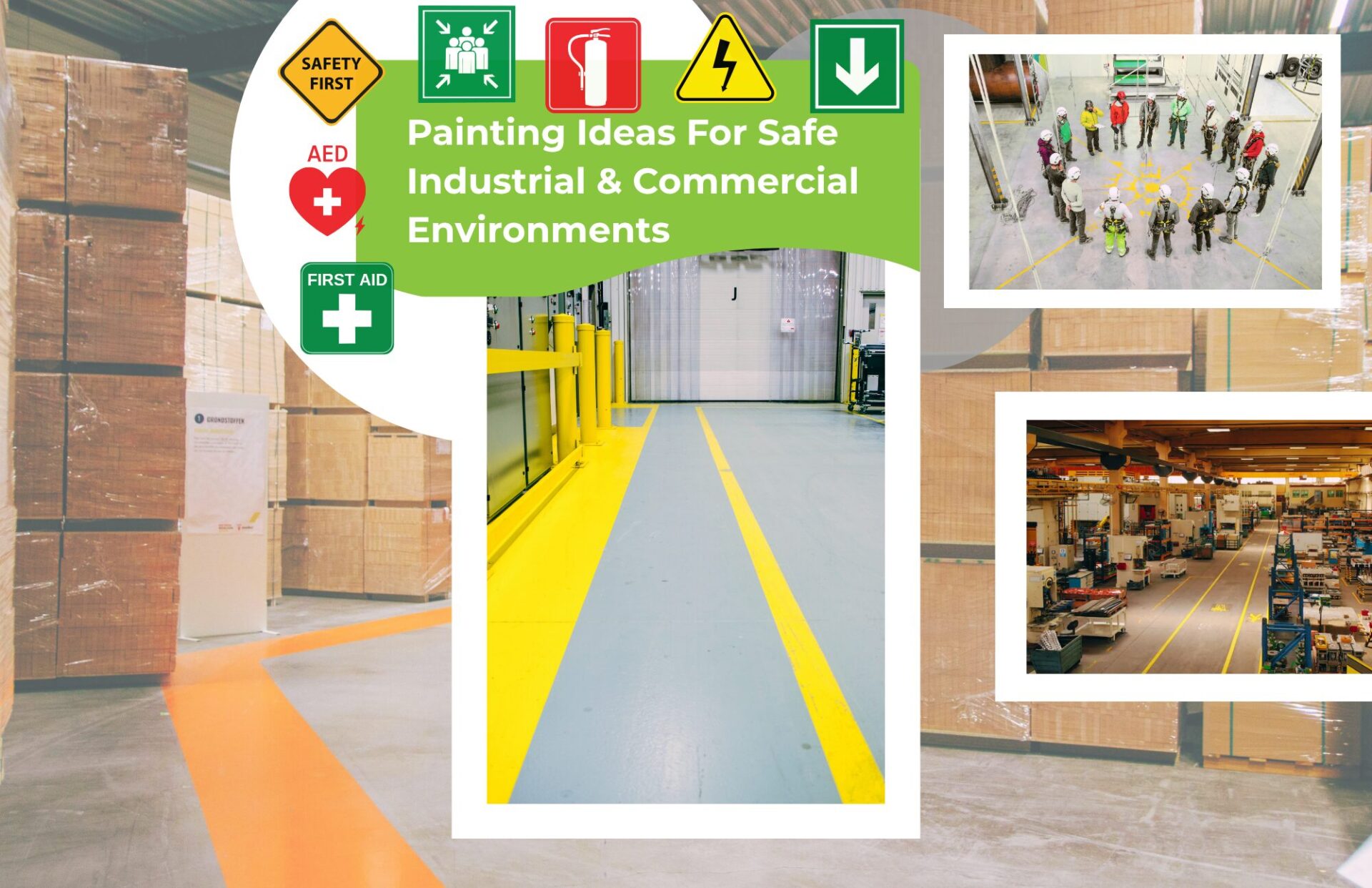
Painting Industrial & Commercial Environments to Enhance Safety

Thoughtful, vigilant painting can help facilitate a safe, standardized environment for all employees, visiting customers, and supplier partners alike.

Applying highly visual, well-planned color combinations & risk-mitigating designations ─ whether on your manufacturing floor, a warehouse & distribution center, around large commercial properties, or even school areas ─ guide the right behaviors and help support a safer environment. Some paint-driven facility safety ideas include:

Color Code Hazards and Safety Zones – use standardized colors to immediately convey potential risk areas such as:

  • Yellow = caution, physical hazards, trip and fall areas
  • Red = fire equipment, emergency stops, prohibited actions
  • Orange = dangerous machine parts or energized equipment
  • Green = safety equipment, first-aid stations, safe areas, or muster points
  • Blue = informational or mandatory-action areas
  • Black & White or Yellow & Black Striping = boundaries and physical hazards

Safe Walking Zones – use paint to designate where people are expected to safely walk without the risk of forklifts, rolling equipment, or hand trucks running into them. An example of using colors to designate status could look like:

  • Yellow lines = pedestrian boundary
  • White lines = designated walkway
  • Crosswalk markings = controlled crossing points

Forklift and Equipment Exclusion Zones – define areas where employees should not stand or where equipment should not be parked. Yellow & black or red & black combinations work well for marking off these types of areas. Some examples include:

  • Forklift operating zones
  • Crane swing areas
  • Loading & unloading areas
  • Electrical panels
  • Machinery borders
  • Material staging areas

Emergency Equipment Areas – brightly painted floor boxes or wall areas can quickly and consistently draw attention to:

  • Fire extinguishers
  • Fire hoses
  • Automated External Defibrillators (AEDs)
  • First-aid stations
  • Emergency showers
  • Eyewash stations
  • Emergency exits

Stairs and Steps Visibility – use high-visibility paint or contrasting markings on:

  • Stair nosings
  • First and last steps
  • Handrail areas
  • Stairwell floors

Changes in Floor Elevation – paint can make otherwise subtle tripping hazards much more apparent. Some potential applications include:

  • Ramps
  • Loading docks
  • Platform edges
  • Pits
  • Changes in floor elevation

Safe Standing Areas Plus Visibility Around Machinery – contrasting paint colors can make machinery and its various areas of functionality easier to see. Some ideas include:

  • Machine footprints
  • Operator stations
  • Maintenance zones
  • Moving-equipment clearance areas
  • Restricted-access areas

6S (Safety, Sort, Shine, Set in Order, Sustain, Standardize) and Tool Shadow Boards Implementations – paint is particularly useful as part of a 6S workplace organization program. Instead of simply telling employees where something belongs, the floor and tool shadow boards visually define its home – and make it obvious to all when a tool or piece of equipment is missing.

One-Way Traffic Flow Reinforcement – painted arrows can establish traffic patterns for:

  • Forklifts
  • Tugger trains
  • Carts
  • Delivery vehicles
  • Pedestrians

Please contact Trusted Coatings Contact TC to learn more about ways we use our commercial painting prowess to make your Central Ohio work environment safer for all employees, suppliers, and customers. Thanks for reading!

What are the Differences between Exterior Paints and Industrial Coatings?

Have you ever wondered, “What is the difference between exterior paints and industrial coatings?”

Not the weightiest philosophical inquiry, I reckon, but important nonetheless when you need to protect your property and assets.

Long story short: the key differences between exterior paints and industrial coatings lie in their intended application, durability requirements, performance needs, chemical formulation, preparations steps, and (you guessed it) cost.

If you’re interested in looking into the distinctions between exterior paints and industrial coatings more deeply, here are some aspects of each:

Exterior Paints

Purpose:

  • Designed for residential or commercial buildings (such as homes, offices, and storefronts).
  • Used primarily for aesthetic appeal and basic weather protection.

Key Features:

  • Easier to apply than industrial coatings (typically using a brush, roller, or sprayer).
  • Provides ultraviolet (UV) resistance, color retention, and moisture protection.
  • Usually acrylic- or latex-based for environmental friendliness and ease of use.
  • Not formulated to handle extended periods of extreme weather conditions or chemical exposures.

Exterior Paint Application Examples:

  • House siding, retail storefronts, trim, fences, decks, sheds, handrails, and garage doors.

Industrial Coatings

Purpose:

  • Designed for harsh environments where surfaces need to withstand chemical exposure, high heat, abrasion, water corrosion, or heavy wear.
  • Focuses more on protection than appearance (although aesthetic appeal can be a secondary benefit to industrial coatings, too. Think of pipes covered in company brand colors or a logo-bearing water tower).

Key Features:

  • Formulated with epoxies, polyurethanes, polyureas (a type of polymer), or fluoropolymers for toughness.
  • Often requires professional application and extensive surface preparation (e.g., sandblasting, priming, and/or electrostatic application – a technique that uses electrical charges to make the coating material adhere more efficiently to conductive surfaces with more precision and reduced overspray).
  • Includes anti-corrosion, anti-slip, chemical-resistant, or fire-resistant properties.

Industrial Coatings Applications:

  • Oil & gas pipelines, steel structures, metal awnings, water tanks, bridges, factories, heavy-traffic warehouses, exposed stairways, lab cabinets, recreational equipment, and machinery.

Now, you have a few distinctions between exterior paints and industrial coatings to consider for your own project. And you’ll be happy to know Trusted Coatings has decades of experience preparing residential, commercial, and industrial surfaces to professionally apply both paints and coatings. Please contact us with any questions you may have.

FOR THE BEST PAINTING SERVICES IN THE COLUMBUS, OHIO AREA

HOW CAN WE HELP YOU BECOME THE NEXT TRUSTED CUSTOMER?

Here at Trusted Coatings we recognize that we are in the service business, and everything we do is designed to put you first. We are dedicated to delivering the best customer experience imaginable, and whether you are a homeowner or general contractor we will earn the privilege to be called Trusted every day!